Friday, September 30, 2011

Mage: The Sorcerers Crusade

When I was thirteen or so, I was really into D&D. I'd played through the Eye of the Beholder games, and read through my treasured core AD&D second edition manuals (whose monster manual remains one of my most prized possessions), and I might have had my nose a bit up in the air. I'd heard of those other games. You know, the ones that are all dramatic and about romantic vampires or philosophy or something. Games produced by White Wolf publishing with names like Vampire: The Masquerade or Wraith: The Oblivion. Their games were, with a few exceptions, set in the modern day - which is what really turned me off. My experience playing D&D had been one of wanton violence - as often perpetrated by PC's as it was by their foes. Grand Theft Auto was still years off, and I still hadn't seen Heat. Thus, the thought of megaviolence in the "real world" was what turned me off, along with the pretentious reputation. Instead, I bought RIFTS, which is all about wanton violence in a magical future with dragons, which my pubescent mind was far more comfortable with.

Then I turned 14 and for my birthday my parents gave me Alternity, along with it's campaign setting, Dark*Matter. I was a little disappointed at the time (the other Alternity setting - StarDrive - looked way cooler), but Dark*Matter sparked an interest in esoteric history, occultism, and related weirdness in my nerdy little brain. I started watching the X-files. I realized that maybe games set in not-fantasyland were probably okay. Especially if they featured as much weird shit as Dark*Matter did. Unfortunately, Alternity was discontinued not long afterwards, after producing just three or so supplements for D*M (a 64 page equipment book, a 64 page gear book, and a 32 page adventure) and a few magazine articles. I started looking around the shelves at Borders, browsing over piles of GURPS books and drifting off to look for a novel when I decided I couldn't find anything.

I flipped through Wraith: The Oblivion, but the setting (a sort of purgatory, run by combination slavers/labor unions) turned me off - most of the fiction was pretty depressing, too. I snapped up Werewolf: The Apocalypse, which introduced me to ecoterrorism as a reason to blow stuff up and fight orcs - ahem, "fomori" - in a modern day setting.

Eventually, I found Mage: The Sorcerers Crusade. When I first flipped through it, I didn't see anything special about it - the velvet-patterned cover was pretty, sure, and some of the interior art was gloriously weird, but I didn't get it. Then my eyes fell on one of the in-game factions names: the Craftmasons, and I was instantly sold.
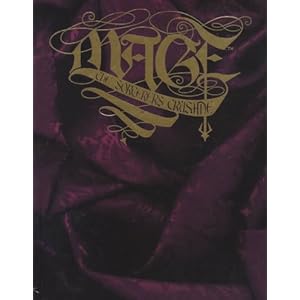
Mage: The Sorcerers Crusade, is a game about wizards set in the early Renaissance. Magic in this particular setting remains more or less hidden from the common folk - the game is set, explicitly, in the shadows of the real world. Magic can create wild effects, but induces a backlash. The further the effects are from what people believe is possible, the worse the backlash. Throwing a lightning bolt at someone on a clear day is vulgar, the universe recoils and you suffer for it. Causing a lightning bolt to strike a man in the midst of a thunderstorm is much less likely to induce the wrath of reality. Every faction has it's own developed style of casting spells.

The prime conflict in the setting centers on the Nine Traditions (a confederation of magical orders dating from ancient times, counting classical wizards and pagans among its numbers, along with a few disenfranchised groups) struggling with the Order of Reason (a council of progressive magical orders, whose spells are more likely to take the form of clockpunk machinary or Da Vinci style inventions) for supremacy. Most open wizardly warfare is over (at least, for now) and PC's may come from either faction and intermingle freely - though that can lead to all sorts of fun tension.

The books of the SC line describe Europe in the 1500's nicely, giving just enough detail to evoke the setting rather than drowning it in miscellany. It also expands into the rest of the world, with magical traditions from China, Africa, the Middle East, and the New World all playing prominent roles. All in all, the game gives an excellent sense of history and inertia to its world - the wars and suffering of mortal men continue, passing by the occult machinations of the magical world.

There is a tremendous variety in the sorts of character available - character generation is points based. The faction and order ones character belongs to primarily influences their magical style, leaving you free to work out the details of the rest of their life. I've rolled up Aztec death-priests bearing obsidian clubs and smirking financiers whose charming manners are a magic all their own. Because magic is it's own sub system (requiring no investment of skill points to improve it, only XP afterwards), what your character does along with being a magician becomes important. It's this variety that makes things so fun - a party from the 9 Traditions might include a hermetic wizard, an Indian death-cultist, an inspired shepard turned prophet of God, and an alchemist in the tradition of John Dee. It's Order of Reason twin would feature reckless explorers in the vein of Drake and Cortez, transgressive doctors whose magic comes from their knowledge of anatomy, Christian knights outfitted with clockwork power armor, and - of course - the craftmasons. Oh, and they have an airship.

The game focuses on providing an interesting world and ways to interact with it. Court intrigue and 'spy games' between the two primary factions compose the majority of the suggested plots, but I could easily see a game where the PC's venture into Africa in search of King Solomons mines, or travel the silk road seeking a fortune, or visit the New World while the Incan Empire still stands. There is a small degree of metaplot (the game is a 'prequel' to Mage: The Ascension, set in the modern day and has a considerably less optimistic tone), but it's contained in a sidebar and is easily discarded.

Mage: The Sorcerers Crusade holds a special place in my heart. It's a beautiful game, with fascinating fiction, an optimistic but troubled setting, and plenty of inspiration for strange and wonderful characters. It's among the first games which truly captured my imagination and got me hooked on buying role-playing games to read, rather than for direct use in an ongoing game. I own almost the entire line (barring just one!) and it still makes me smile to see it on the shelf.

I think I'll take 'em down and roll up somebody based on Littlefinger from A Song of Ice and Fire - not a nice man, but a pragmatic one. Combine that with some magical ability with death and fate, and, welll...

---

On further reflection, it also probably helped that I'd started getting into some of the weirder corners of the used book store around the same time I got Dark*Matter, and read The Drawing of the Dark by Tim Powers.

---

As a general formatting note, I'm trying to link games I mention as I go. I prioritize game-specific wikias, followed by Wikipedia articles, followed by amazon links. Unfortunately, some games or books have very little specific information about them online.

Thursday, September 29, 2011

Space 1889

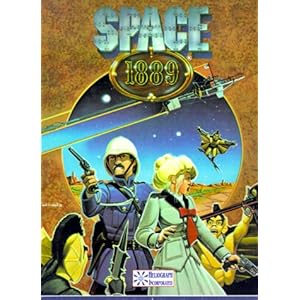
Written by Frank Chadwick way back in 1988, Space 1889 is tough to classify. It isn't out and out steampunk - it lacks, mostly, the 'punk' aspects - the player characters are often well off, rarely oppressed, and pretty much heroic. Similarly, very little of the setting is 'steam' - most of the technology in use comes from more esoteric sources. Really, Space 1889 is what you get when you imagine what Jules Verne would write if he penned an RPG. You have colonial ambitions being played out on Venus (the jungle planet) and Mars (partly arid and sometimes lush - a stand in for Afghanistan and India), with technology remaining largely Victorian (the Maxim gun is the pinnacle of infantry weaponry, for example) with dashes of weirdness - inventors have introduced tripods (looking quite similar to those found in the War of the Worlds), electro-guns, and other strangeness. In amongst all this, ether-flyers - that is, spaceships - have been invented. The game treats aether theory as truth, and so these spaceships travel through the stuff using strange principles. They don't have the range to reach the outter system yet, but humanity is beginning to spread to the stars.

The games focus is unabashedly European. The player characters are assumed to be British or otherwise European, and the notes on social class are especially Victorian British. I don't know that it would be much trouble working in American player characters, but I think it might be missing the point, a little. While some information is provided on people and places on Earth to find adventure (especially in places like the far east, Africa, and the Americas), most of the setting information is on Venus (replete with dinosaurs, lizardmen, and ancient ruins) and Mars (with it's dying canal-building civilization now subjugated by the British), with some notes on adventures set on the Moon (still largely unexplored, as it has no atmosphere) and stranger places.

Diagram of an ether-flyer.
The game is very much sci-fi. No magic or telepathy of the like has been shoe-horned in. It's a game of pulp heroics and 'scientific' adventures - just writing this I had the epiphany that the first aether-flyer expedition to the moons of Jupiter could form the basis of an entire campaign - with a Victorian backdrop and a healthy degree of optimism. Though the PC's are expected to face terrible odds and strange cultures, they're equipped with the technology and the know-how (or the charm to acquire those things) from the get-go.

Space 1889 is an older game, and it shows. While the basic system is endearingly simple (attributes range from 1-6, as do skills, attributes affect how expensive related skills are, roll-under resolution), it becomes needlessly complex in several places - providing two entirely unrelated methods to resolve tasks, requiring a separate skill to determine initiative; the confusingly named "close combat". Additionally, while a good portion of the games art is excellent (with strongly drawn characters in black and white, with an appropriately 19th century feel), the color inserts art is atrociously bad, with hideously drawn damsels in distress being menaced by slimy phallicness or being rescued by oddly-proportioned heroic types.

But setting aside it's rules problems (largely fixable with a few quick house rules) and ignoring a few examples of crap art, Space 1889 manages to create a viable setting for pulp adventure in the vein of Verne and Wells without crossing into camp or excessive seriousness.

Every RPG fan knows that formatting is everything.

Formatting is something folks don't consider often. Mostly because good formatting doesn't draw attention to itself, but to the content. Bad formatting either places itself ahead of the content, or organizes things so poorly as to make something simple needlessly complex.

I'll draw an example of the first type of bad formatting from a game I love: the Secret of Zir'an, a game published by Arthaus, an imprint of White Wolf. It's a neat mashup of fantasy and pulp elements - imagine Eberron with a much stronger 1940's feel and a little more gonzo, and you're coming close. The games system was only okay (I can barely remember what kind of dice it uses, honestly), but it's setting was fantastic. Unfortunately, the setting chapter was a mess - the pages of the book were black text over a patterned background, usually a stone tablet or something similarly atmospheric. That wasn't so bad when the text on the tablet (in the made up fantasy language, of course) was light gray and didn't detract from reading the rules. In the setting chapter, though, the text on the tablets became dark black, which turned that chapter into an unreadable mess. It looked cool - they symbols were well designed and you could even translate them, if you flipped to the GM chapter - but it made reading the setting chapter a chore, and whole paragraphs of it remained illegible.

The second type of bad formatting is more prosaic in nature - poorly organized rules and setting information are a hallmark of another game I love: Rifts. Written in an idiosyncratic style that hasn't changed since the 1980's, Rifts uses numbered lists to outline character class features (for no apparent reason - there is no reason they wouldn't just use paragraphs), places the rules on combat in the midst of the skills chapter (and then doesn't explain how to use missiles - an important factor in most fights!) until the vehicles chapter. The end result is either a lot of improvising by the GM or constant page-flipping. The setting books are even worse - while they positively drip with flavor and cool stuff for PC's to do, they often do annoying things like stick a very usable PC class in the middle of a write-up on part of the setting that is secret to most player characters - for example, in Rifts Underseas, the Salvage Operator O.C.C (basically, somebody who can fight, use a boat really well, and knows some engineering/demolitions) is placed right next to a page describing the evil and ultra-secretive Naut'yll civilization, who eat hapless sailors investigating shipwrecks. A combination of spoilers and, well - I wouldn't be very encouraged about playing a salvage operator after reading that.

But all that is mostly meandering on my part. What I really mean to talk about in this post is the format I'm planning on following in talking about games here. I'd like to focus on a single line per post - sometimes I'll zoom in on a specific book, or even go through a line more or less book by book. I'm not planning on these being proper reviews - really, it's more me gushing about stuff I like - but I'm going to follow a review-like format, maybe listing out what I own for that given line. I'm going to be pretty honest too - some of the games I love, I love in spite of themselves.  Don't expect numbered review scores or a thumbs up/thumbs down - do expect me to tell you what's awesome about any particular game, along with the little (and sometimes the big) bits that stick in my craw.

Hello, and whats the point?

Hi, my name is Morgan, and I buy a lot of role-playing game books, starting pretty much since I've had a disposable income and continuing even when I didn't. For a while, I was obsessive about collecting whole lines to complete parts of my collection. I've gotten past that, but I still buy what could be described as an excessive number of books. Currently, they fill a dozen boxes and most of a closet, along with a few more scattered boxes - and that isn't including the ones scattered around that I'm in the midst of reading or otherwise fooling around with. This is my hobby - collecting and playing RPGs.

I do get some use from parts of my collection - I've run quite a few of them, and stolen ideas from the rest, but a slim majority have seen no more use than a read-through and being organized with the rest of whatever game line they come from. I've long since sold off the true cruft (especially, most of my third party/SRD games) and most of what I have left I either find very cool or, in a few cases, bear some sort of nostalgia value or may someday be worth some money. That last part is probably wishful thinking on my part, but collectors are entitled, I think, to be a little bit attached to that which they've collected. Sure, I may never make use of Castle Falkenstein, but I still remember stumbling across it in a used bookstore on the Oregon coast and snapping up one of the earliest examples of steampunk gaming. For that, it's earned its place on my shelf.

Recently, I've placed a bit of a moratorium on further purchases of RPG's. This came after I snagged a setting book for Anima: Beyond Fantasy, which was full color, well written, and more money than I ought to have spent on something I'll very likely never make serious use of. My purpose with this blog is to turn inward a bit - to go hunting through the boxes and the shelves for those cool old games I snapped up on a whim and never gave a proper look. It's to rediscover the games that grabbed my imagination so hard I chased them down an almost never-ending line of supplements. It's to share my love of role-playing games.