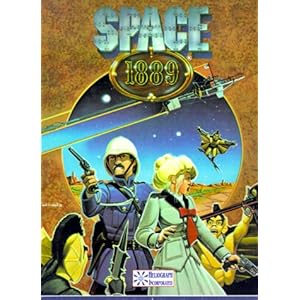
The games focus is unabashedly European. The player characters are assumed to be British or otherwise European, and the notes on social class are especially Victorian British. I don't know that it would be much trouble working in American player characters, but I think it might be missing the point, a little. While some information is provided on people and places on Earth to find adventure (especially in places like the far east, Africa, and the Americas), most of the setting information is on Venus (replete with dinosaurs, lizardmen, and ancient ruins) and Mars (with it's dying canal-building civilization now subjugated by the British), with some notes on adventures set on the Moon (still largely unexplored, as it has no atmosphere) and stranger places.
 |
| Diagram of an ether-flyer. |
Space 1889 is an older game, and it shows. While the basic system is endearingly simple (attributes range from 1-6, as do skills, attributes affect how expensive related skills are, roll-under resolution), it becomes needlessly complex in several places - providing two entirely unrelated methods to resolve tasks, requiring a separate skill to determine initiative; the confusingly named "close combat". Additionally, while a good portion of the games art is excellent (with strongly drawn characters in black and white, with an appropriately 19th century feel), the color inserts art is atrociously bad, with hideously drawn damsels in distress being menaced by slimy phallicness or being rescued by oddly-proportioned heroic types.
But setting aside it's rules problems (largely fixable with a few quick house rules) and ignoring a few examples of crap art, Space 1889 manages to create a viable setting for pulp adventure in the vein of Verne and Wells without crossing into camp or excessive seriousness.

No comments:
Post a Comment